How Race Clocks Turned Elapsed Time Into Part of the Finish
Race clock history explains how elapsed-time displays help spectators follow pace while official timing rules determine what counts as a result.
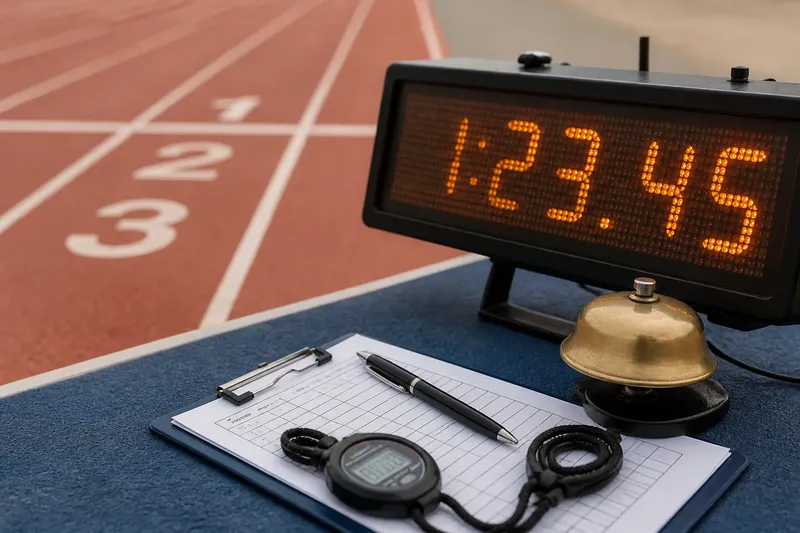
At a track meet, a runner can cross the line while the stadium clock keeps ticking for athletes still on the course. That gap between the public display and the official result is central to race clock history: a visible clock made elapsed time part of the event, but it did not replace the rules or officials that decide what the numbers mean.
Race clock history is about more than a changing display
A finish judge can identify who crossed ahead in a head-to-head race. A clock answers a different question: how much time passed between the defined start and finish? Those records serve different purposes, and neither automatically substitutes for the other.
It is safer to describe the development broadly than to suggest one universal moment when racing adopted clocks. Events use different formats and procedures, and a public display may have a different role from the equipment used to record an official result. The enduring change is straightforward: elapsed time became something competitors, officials, and spectators could follow alongside position.
A handheld stopwatch gave a timekeeper a way to record duration. A large trackside clock let a crowd see time accumulate as the race unfolded. The display could help spectators follow an attempt or understand pace, while officials still needed a defined start, finish, and method for confirming the result.
Public clocks added a second story to the race
In a close head-to-head finish, attention naturally goes to who reaches the line first. In a time trial or a solo record attempt, the clock can become the main public reference because the athlete is racing against a target as well as against the course.
That visible number changes what people watch. Spectators can see whether an attempt is moving toward its intended time, and a competitor may use the display as a pace cue where the event allows it. But the clock does not explain effort, tactics, or why a performance changed. It records duration, not the whole race.
A public clock can also be provisional, rounded for display, or intended to serve the event rather than settle a close placing. The number shown to the crowd may not include all the detail officials use. Treat the display as useful context until the event posts or confirms its result.
Manual timing depended on coordinated human reactions
With manual timing, a timekeeper starts a watch in response to the start signal and stops it at the finish. The method produces a record, but the signal, the official’s reaction, and the button press are separate events. If officials do not share a clear procedure, their readings may differ.
That does not mean an official has been careless. It reflects the challenge of matching a person’s reaction to a precise event. Rules clarify which start and finish moments count, and officials use those rules to interpret the timing record alongside finish-line observations.
- Check the published timing method. If the event identifies manual timing, treat the watch reading as the method the rules specify; if it identifies electronic timing, look for the corresponding official record instead.
- Check what starts the clock. If the rules tie timing to the start signal, interpret elapsed time from that signal; if they define another reference, use that event’s stated reference.
- Check whether the display is provisional. If it is labeled or presented as provisional, wait for the confirmed result; if it is not, still consult the posted result when a placing is close.
- Check the finish procedure. If officials use finish-line observation to settle order, follow the recorded placing; if the event uses another stated method, read the result under that method.
- Check whether the display serves later finishers. If the clock continues after one athlete finishes, read it as an event or elapsed-time display; if it stops for each athlete, it may be showing an individual reading.
- Check for a revised result. If officials post an updated result, use that version; if no revision appears, avoid treating an indistinct display as evidence of a tie.
Say a runner sees a trackside display stop at the same visible reading for two finishers. The runner checks the event’s posted result, sees that it lists the athletes in separate places, and follows that official order rather than assuming the display proves a tie. The useful distinction is between what the crowd can read and what the event’s procedure records.
Why can race clocks and official results differ?
Does the visible clock decide who won?
Not necessarily. The display may show elapsed time for spectators, while the event uses its stated timing and finish procedures to determine the result.
Why might two displays show different times?
Displays can differ in their start reference, rounding, or update timing. Check the event’s published method to know which record officials use.
How are elapsed time and finish order different?
Elapsed time is the duration between defined start and finish points. Finish order records who crossed ahead, which can decide a head-to-head race even if displayed times look alike.
Why does a clock keep running after an athlete finishes?
It may be tracking the event for later finishers rather than stopping for each athlete. Read the display according to its purpose and the event format.
Electronic timing connected the start, finish, and record
Electronic systems can link signals, sensors, or finish-line images to timing records, depending on the event. A public display may relay one reading while officials review a separate record. The equipment can capture information, but the event’s rules still determine how that information is used.
Officials may need to confirm that the system recorded the correct event or to resolve a situation the equipment cannot settle by itself. A more elaborate display does not necessarily tell spectators which record is authoritative. The useful question is what the system records and which procedure the organizers apply.
A local meet may use a simpler arrangement than a major championship, and that is not a problem by itself. The relevant issue is whether the event’s method is clear and whether the result is reported under its rules.
What should spectators look for when a clock seems decisive?
Start by distinguishing a running display from a confirmed result. If the clock and the finish seem to conflict, check the event’s posted timing method, whether the displayed time is provisional, and where officials publish the final placing.
It is not worth the effort to decode every digit or infer a timing system’s technical details from the stands. For most spectators, knowing whether a display is provisional and where the official result appears is enough to follow the decision.
Race clock history matters on race day because a visible number can make elapsed time immediate without making it self-explanatory. Read the display as evidence about duration, then use the event’s rules and confirmed result to understand what that duration means.