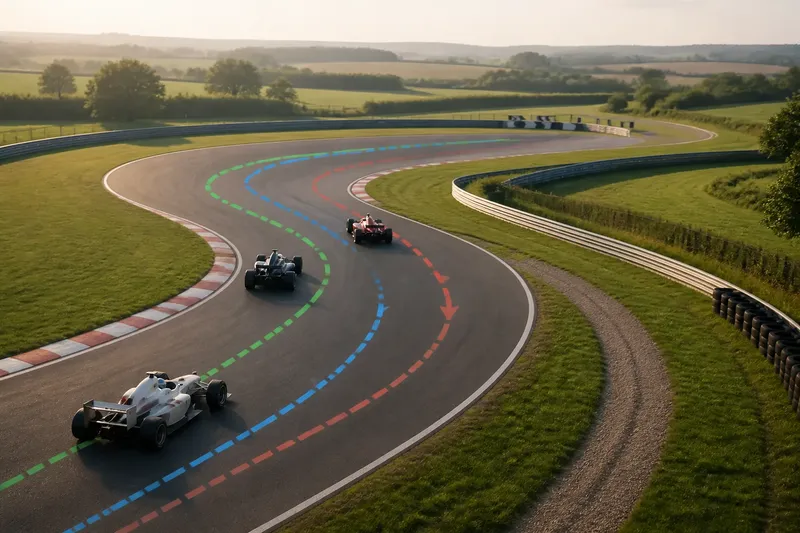
Oval or Figure Eight: Two Course Shapes, Different Demands
Oval or figure-eight course design affects what spectators can follow. Compare sightlines, turning patterns, and crossings to choose a layout that suits your race.

Oval or figure-eight course design changes what spectators can follow from the sidelines. Choose an oval for a repeating circuit that is easy to read; choose a figure eight when a visible crossing is central to the race’s appeal.
Neither shape is automatically more exciting or demanding. The better choice depends on the movement your event calls for and whether spectators can see enough of the route to understand it.
An oval makes repeated movement easy to read
An oval gives racers a continuous loop, with turns grouped at the ends and straighter sections between them. Because the pattern repeats, competitors can settle into a rhythm, and spectators can anticipate where the next turn or pass may happen.
This shape suits a race where sustained pace and comparisons across laps matter. A spectator can watch the same section repeatedly and notice changes in spacing or position. For a field of racers, a consistent direction of travel also helps newcomers understand the flow.
Each lap can still feel different. A tight bend asks for a different approach from a broad curve, and the transition from straight to turn affects how racers carry their movement. The overall pattern remains legible because everyone keeps circulating around the same loop.
Consider an oval when the viewing area is narrow, many spectators are new to the sport, or the event depends on a steady sequence of laps. It is also a natural fit when you want the audience to compare repeated action at one visible point.
A figure eight makes the crossing a focal point
A figure-eight course joins two loops at a crossing point. Racers pass through that shared area as they move between loops, creating a recurring moment when paths appear to converge before separating again.
This changes how spectators follow the race. Instead of tracking one consistent circuit, they need to notice which loop each racer is completing and when competitors arrive at the intersection. Movement gathers at the crossing, then spreads across the two loops.
A figure eight suits an event where interaction and changes of direction are part of the intended spectacle. The crossing can give spectators a clear place to focus if it is visible from the main viewing area. But the route takes more explaining: spectators need to know the direction of travel and how the two loops connect.
The crossing is not just a visual flourish. It shapes how racers approach and leave the shared area, and it can make the route harder to read if the loops look alike or the viewing angle hides part of the course. Choose this shape only when spectators can see the intersection and distinguish the loops.
Choose a course shape from the spectator’s view
Start with the audience’s view, not the diagram on paper. Walk the intended viewing area and trace the route with your eyes. On an oval, can spectators see enough of the loop to understand who is ahead? On a figure eight, can they see the crossing and tell which loop racers enter next?
Imagine you are planning a small community race on a field with one long, unobstructed sideline and an audience that includes first-time viewers. For this invented situation, the oval is the stronger option: its repeated loop is easy to explain from one viewing area, and spectators can watch the same turn as racers pass. If the same field instead had a central viewing area with clear sightlines to a shared intersection, a figure eight could make that crossing the focal point. In either version, the expected result is a route people can follow from where they stand.
Also consider how often spectators need to redirect their attention. An oval concentrates turns at its ends. A figure eight spreads movement across two loops and brings it back to the crossing. The first offers a more continuous read; the second rewards attention to a particular encounter point.
How do the two course shapes compare?
Which layout is easier for a first-time spectator?
An oval is usually simpler to follow because racers repeat one continuous loop. A figure eight can also be clear when spectators can see the crossing and both loops, but it benefits from a brief explanation before the race.
Which shape puts more emphasis on the crossing?
A figure eight builds a shared crossing into the route, making arrivals and departures there natural viewing moments. An oval has no comparable intersection; its turns and straights provide recurring landmarks instead.
Can an oval still create varied movement?
Yes. Curve width, straight length, and the way a turn meets a straight can make sections feel distinct. The route remains a continuous loop, but racers approach different parts in different ways.
What should organizers check before choosing?
Check sightlines, route clarity, crowd position, and whether spectators can see the action the event is meant to showcase. If a crossing or turn raises questions about safe layout, follow venue rules and consult qualified guidance rather than improvising.
Use clear cues to explain the route
A course shape works best when spectators can connect what they see to where racers are going. For an oval, explain the direction of travel and point out the turns. For a figure eight, identify both loops and the crossing before the start, using a course map or a clear view from the spectator area.
It is not worth adding decorative markings or route details that do not help racers or spectators understand the course. Keep visual cues focused on the path, and do not make the crossing look like a separate finish or turn if it is simply a shared point on the route.
When comparing oval or figure-eight course design, choose the shape that makes the race easiest to follow from the actual viewing area. An oval offers a repeating circuit; a figure eight makes the crossing an encounter point. A walk along the spectator area can reveal which pattern will make sense before racers arrive.