The Myth of the Perfect Racing Line
Perfect racing line choices depend on the approach, traffic, surface, and next turn. Learn to read each bend and choose a path that sets up what follows.
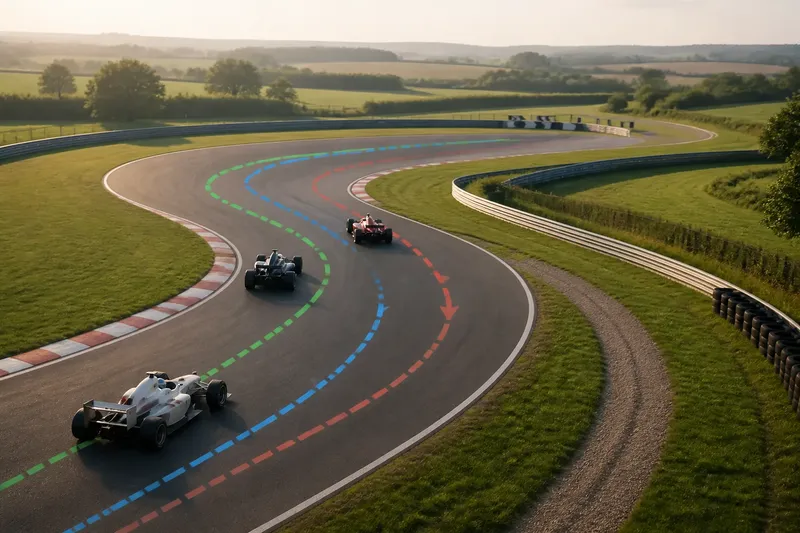
The perfect racing line is not one fixed arc that every racer should trace through every bend. A line that looks textbook on its own can leave you on the wrong side for the next turn or with no room to respond to traffic. The useful choice depends on the approach, the space available, and what comes next.
That is the misconception to set aside: there is no single ideal path that stays ideal in every situation. Instead of asking only where to touch the inside of a corner, ask where you need to be when it ends. That question makes the line a decision rather than a diagram.
Read the sequence before choosing a line
A bend rarely acts alone. The approach determines how much room you have to set up, and the exit determines your position and momentum for the next demand. Before committing, look beyond the turn for the next change in direction, width, or traffic.
On a course with two linked bends, the first may be best treated as a setup for the second. A tight path through the first can feel satisfying but leave you on the wrong side for the following turn. A slightly wider arc may make the next bend easier to open up.
Keep a simple mental sequence: approach, turn, exit, next demand. The apex, or point nearest the inside of the bend, is only one part of that sequence. It is not the purpose of the turn.
Let your starting position shape the available path
The ideal entry depends on where you begin and how much space is usable. A wide approach may allow a gradual turn-in and broad arc. A barrier, crowded approach, or nearby racer may rule that out. Choose a path you can take cleanly from your actual position instead of forcing a preferred one.
This matters in close racing because available space changes. If another racer holds the inside, the outside may be the clear route. If the pack spreads across the track, a late move toward the apex can close a gap that seemed open a moment earlier. Respond to the space that exists, not the space you hoped to have.
Sightlines matter, too. A hidden exit calls for restraint because you cannot yet see how much room will be available. On an open bend, a more direct approach may be easier to judge. Either way, a smooth-looking entry only helps if you can control it and complete the turn.
Choose an apex that supports the exit
The apex is not a fixed target. An early apex brings you toward the inside sooner; a later one delays that move and may leave more room to open your path toward the exit. Which suits the bend depends on what lies beyond it.
For a bend opening onto a straight, preserving forward drive through the exit may matter more than hugging the inside early. A later apex can help you finish turning before accelerating or settling into the next phase. A short bend followed by another direction change may instead reward a tighter route that keeps you positioned for that move.
“Late apex” is not a magic answer. If the turn is short, the exit is constrained, or traffic occupies the outside, delaying the apex may leave too little room. Aim to finish the bend in a position that supports the next demand.
Match the line to what the next section requires
A straight may reward an exit that lets you carry speed and settle into a useful lane. A tight bend may make positioning more important than a fast exit from the preceding turn. A narrow passage may call for a predictable line with room to respond.
Imagine a fictional course with a broad left bend followed by a narrow right turn. You enter the left bend near its inside, then drift outward and arrive on the wrong side for the right. On a permitted practice run, you instead take a slightly wider path through the left and hold a position that lines up with the narrow turn. The observable result is a clearer approach with room to make the right turn; the tradeoff is giving up the tightest path through the first bend.
When a straight follows, the tradeoff may reverse. A path that takes longer to reach the apex could make the exit more open. Compare what the choice costs in this bend with what it makes possible just afterward.
Separate a clear racing line from a passing line
The fastest unobstructed route and the best route in traffic are not always the same. Behind another racer, you may need to leave space, avoid a blocked inside, or stay positioned to respond if the rival changes course. Trying to copy an ideal line through occupied space can turn a useful plan into a poor one.
Look for a route that remains predictable. A sudden cut toward the apex may surprise a racer alongside, while a steady outside path may preserve room to continue through the bend. Follow the rules and layout, and do not assume a line is available just because it looks geometrically attractive.
Entering side by side can compromise both racers’ exits. That may still be a sensible choice if the position matters, but it is different from taking the clearest line alone. Judge the move by its likely effect on the next section, not just by who reaches the apex first.
Check the surface and usable track
A path on a map may not match the usable racing surface. The outer edge could be rough, a painted area could offer less grip, or course boundaries could limit how far you can move. A broad arc that relies on uncertain space is not dependable just because it looks smooth.
From a safe, permitted vantage point, note the surface and official course markings. Weather and event setup can also affect the usable area. Follow organizer instructions and equipment guidance rather than guessing from appearance where a surface is permitted.
- If the course marking places an edge outside the permitted surface, keep the line inside it; if the marking is unclear, check the organizer’s instructions before relying on that edge.
- If the outer surface looks rough or offers uncertain grip, choose a path that stays on the familiar surface; if the whole bend is affected, reduce your commitment and follow event guidance.
- If a painted area appears to have different grip, avoid treating it as equivalent to the main surface; if its status matters to your route, ask an official or consult the course rules.
- If weather has changed the visible surface, reassess the line before the bend; if conditions remain uncertain, use a more conservative path and follow the organizer’s direction.
- If a barrier or another racer reduces the usable width, select a line that fits the space remaining; if no clear path remains, do not force the turn.
- If the exit leaves too little room for the next direction change, adjust the approach on a permitted run; if that adjustment crowds another racer, keep the predictable path and prioritize clear space.
It is not worth trying to trace an exact geometric curve. Small variations are normal, and chasing a perfect-looking arc can distract you from traffic, balance, or the next turn. Aim for a repeatable path that fits the surface and leaves room for correction.
Review the exit to judge whether the line worked
A useful review starts at the exit, not just the entry. Did you leave the turn with room to accelerate, change direction, or hold a lane? Did the chosen apex force an awkward correction? Those observable results tell you more than whether the path looked smooth from the stands.
Say you are practicing on a quiet circuit and an early apex repeatedly sends you toward the outside boundary before a second bend. You note your starting position, the early apex, and where you exit. On a permitted practice run, you shift your turn-in slightly later, then observe whether the exit leaves more room for the next direction change. The resulting answer is specific: if the new exit gives you more room without forcing a correction, it may suit that sequence; if it does not, return to the prior line or adjust another choice on a later run. This invented scenario compares control and position, not universal speed.
Change one decision at a time where conditions allow. If you alter the entry, apex, and exit together, it becomes harder to tell which choice affected the result. Keep the review simple: starting position, chosen path, exit position, next section.
What should you ask about a racing line?
Is the racing line always the shortest route?
No. The shortest route through one bend may create a poor exit or leave you badly placed for the next section. A useful line balances the corner with the route that follows.
Should you always aim for a late apex?
No. A later apex can support an open exit, but it may not fit a short bend, limited space, or an immediate direction change. Choose the apex that leaves a workable position afterward.
How should you choose a line when another racer is beside you?
Start with the space that is actually clear and keep your path predictable. Do not assume the preferred inside or outside route is available; consider how your choice affects both the bend and the next section.
What should you watch after a corner?
Notice your position, control, and room to continue rather than judging only how close you came to the apex. The exit and next demand show whether the line served its purpose.
The perfect racing line is a choice for a particular approach, bend, and exit, not a curve to copy everywhere. Judge each racing line by where it leaves you next, and you will have a clearer basis for adapting when the course, surface, or traffic changes.